Key Takeaways
- 60% of open proposals remain undecided due to administrative friction and consumer distraction, not price rejection.
- 74% of local service sales representatives abandon follow-up after a single unreturned phone call or email.
- A structured 30-day, multi-channel nurture sequence that automatically pauses upon customer engagement recaptures hundreds of thousands in pipeline value.
- Educating opportunities through automated case studies, warranty details, and payment options removes friction without damaging brand positioning.
The Anatomy of Proposal Abandonment: Why Qualified Opportunities Go Silent
Consider the standard proposal workflow: a sales representative conducts a thorough onsite consultation, calculates detailed job costs, and emails a comprehensive $12,000 estimate. The prospective opportunity opens the document, feels genuine interest, but becomes sidetracked by daily workplace demands, personal obligations, or family logistics.
Three days later, the representative sends a generic email: "Just checking in to see if you had any questions on the quote." The prospect intends to reply later, but the email sinks beneath incoming messages. The representative concludes: "They thought we were too expensive," and stops following up entirely.
In reality, the prospect never rejected the proposal; they simply encountered friction. Without systematic, multi-touch sales automation, that $12,000 project dissolves into thin air, forcing the business to purchase more ad traffic to replace lost pipeline revenue.
The Price Resistance Fallacy: Understanding Real Buyer Psychology
Business owners routinely attribute lost quotes to price sensitivity. While price plays a role in every commercial transaction, telemetry reveals that price resistance accounts for less than 20% of unclosed proposals.
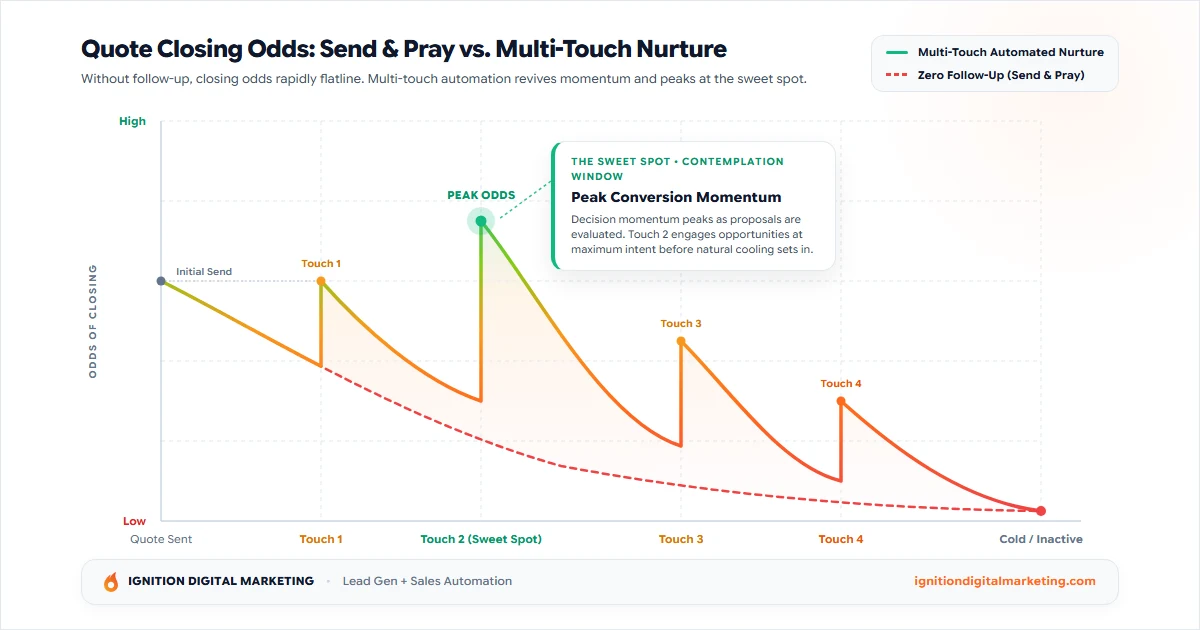
The primary driver of lost quotes is decision paralysis. High-value local services involve complex logistics, scheduling decisions, financing questions, and trust evaluations. When a business delivers a quote and disappears, the burden of momentum rests entirely on the customer.
Systematic follow-up removes this burden. By providing structured value touchpoints, scope walkthrough videos, financing options, material warranty clarifications, and peer case studies, you dismantle inertia and guide the opportunity toward a confident purchasing decision.
The 30-Day Multi-Touch Nurturing Architecture
Our Sales Automation deploys an intelligent, 30-day sequence engineered to maintain engagement without appearing desperate or intrusive.
| Timeline | Channel | Psychological Objective | Tactical Execution |
|---|---|---|---|
| Day 1 (Instant) | SMS + Email | Immediate Clarity & Orientation | Video link explaining proposal line items, warranties, and scope milestones |
| Day 3 | SMS | Local Social Proof & Validation | Geo-targeted case study summary of a completed project in their immediate area |
| Day 7 | Financial Friction Removal | Transparent breakdown of monthly payment options, deposits, and payment structures | |
| Day 14 | SMS | Scarcity & Installation Scheduling | Operational notification regarding upcoming seasonal installation and dispatch windows |
| Day 21 | Scope Flexibility Consultation | Direct inquiry exploring whether phase-1 staging or scope adjustments would better align with goals | |
| Day 30 | SMS | Professional File Closure | Courteous closing notice releasing reserved equipment/time slots to the next opportunity in queue |
This structured cadence ensures your brand remains top-of-mind throughout the entire consideration window, maximizing the potential of every proposal submitted.
The Conversational Auto-Pause Mechanism: Seamless Real-Time Handoff
A fatal flaw of crude email marketing sequences is sending automated follow-up messages after a customer has already replied or asked a specific question. Nothing shatters trust faster than receiving a generic "checking in" email an hour after texting a detailed scheduling inquiry.
Our backend automations utilize real-time conversational triggers. The millisecond an opportunity responds via SMS or email ("Can we start next Tuesday?" or "Does this price include site permits?"), the automated sequence pauses instantly.
Simultaneously, a high-priority alert routes the conversation directly to your sales team's mobile CRM app with complete proposal history and notes. Your internal representative steps into an active, high-intent dialogue to close the deal.
Eliminating the "Too Pushy" Stigma: Value-Driven Messaging
Many sales teams resist systematic follow-up because they fear annoying prospects. This fear stems from outdated sales tactics that repeatedly ask for money without providing value ("Are you ready to buy yet, ").
Value-first follow-up flips this dynamic. Each touchpoint delivers useful information that aids the customer's decision-making process: warranty terms, material comparisons, municipal permit guides, and case study photos. The customer perceives your business not as a pushy vendor, but as a knowledgeable, highly professional consultant.
Pipeline Telemetry: The Compounding Revenue Impact of a 15% Conversion Lift
The financial impact of sealing your quote pipeline is dramatic because it requires zero additional marketing spend. Consider a local service company submitting 40 quotes per month at an average project value of $8,000 ($320,000 in monthly proposal volume).
If their closing rate increases from 25% (10 closed projects = $80,000) to 37.5% (15 closed projects = $120,000) through automated 30-day nurturing, the business captures an additional $40,000 in monthly revenue ($480,000 annually) with zero added advertising expense.
Learn how Sales Automation recovers lost quote pipeline or book an inbound audit to calculate your business's specific recovery potential.