Across hundreds of local business audits—spanning commercial contractors, medical clinics, legal firms, and specialized service operators—the single greatest source of lost revenue is rarely lead volume. It is open, unclosed estimates sitting silently in dispatch software, spreadsheets, and email inboxes. Over 60% of high-intent opportunities decide on a provider after the third touchpoint, yet three out of four sales teams abandon follow-up after just one attempt.
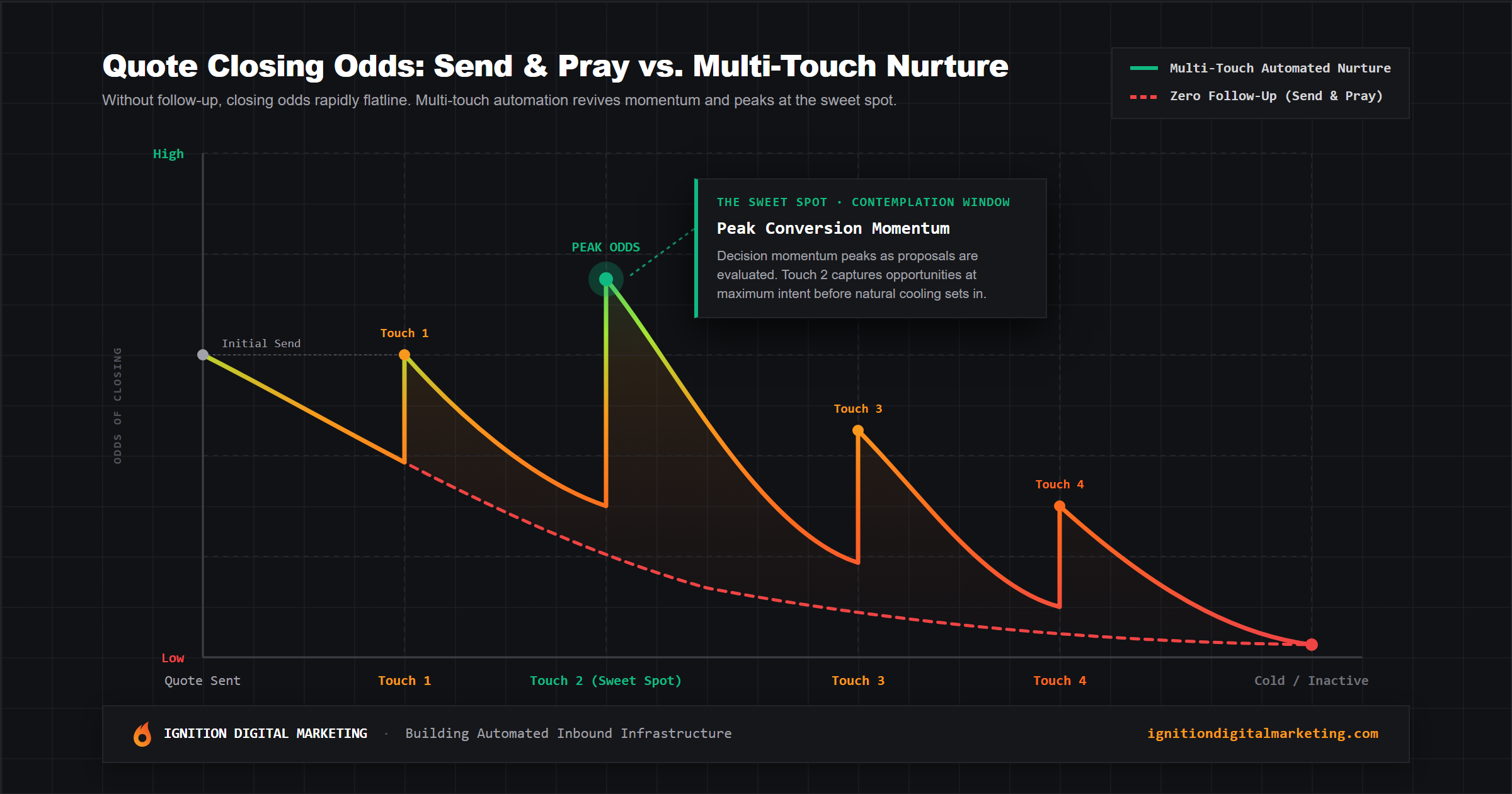
The Anatomy of Proposal Abandonment: Why Qualified Opportunities Go Silent
Consider the standard proposal workflow: a sales representative conducts a thorough onsite consultation, calculates detailed job costs, and emails a comprehensive $12,000 estimate. The prospective opportunity opens the document, feels genuine interest, but becomes sidetracked by daily workplace demands, personal obligations, or family logistics.
Three days later, the representative sends a generic email: "Just checking in to see if you had any questions on the quote." The prospect intends to reply later, but the email sinks beneath incoming messages. The representative concludes: "They thought we were too expensive," and stops following up entirely.
In reality, the prospect never rejected the proposal; they simply encountered friction. Without systematic, multi-touch nurture infrastructure, that $12,000 project dissolves into thin air, forcing the business to purchase more ad traffic to replace lost pipeline revenue.
The Price Resistance Fallacy: Understanding Real Buyer Psychology
Business owners routinely attribute lost quotes to price sensitivity. While price plays a role in every commercial transaction, telemetry reveals that price resistance accounts for less than 20% of unclosed proposals.
The primary driver of lost quotes is decision paralysis. High-value local services involve complex logistics, scheduling decisions, financing questions, and trust evaluations. When a business delivers a quote and disappears, the burden of momentum rests entirely on the customer.
Systematic follow-up removes this burden. By providing structured value touchpoints—scope walkthrough videos, financing options, material warranty clarifications, and peer case studies—you dismantle inertia and guide the opportunity toward a confident purchasing decision.
The 30-Day Multi-Touch Nurturing Architecture
Our Inbound Infrastructure deploys an intelligent, 30-day sequence engineered to maintain engagement without appearing desperate or intrusive.
| Timeline | Channel | Psychological Objective | Tactical Execution |
|---|---|---|---|
| Day 1 (Instant) | SMS + Email | Immediate Clarity & Orientation | Video link explaining proposal line items, warranties, and scope milestones |
| Day 3 | SMS | Local Social Proof & Validation | Geo-targeted case study summary of a completed project in their immediate area |
| Day 7 | Financial Friction Removal | Transparent breakdown of monthly payment options, deposits, and payment structures | |
| Day 14 | SMS | Scarcity & Installation Scheduling | Operational notification regarding upcoming seasonal installation and dispatch windows |
| Day 21 | Scope Flexibility Consultation | Direct inquiry exploring whether phase-1 staging or scope adjustments would better align with goals | |
| Day 30 | SMS | Professional File Closure | Courteous closing notice releasing reserved equipment/time slots to the next opportunity in queue |
This structured cadence ensures your brand remains top-of-mind throughout the entire consideration window, maximizing the potential of every proposal submitted.
The Conversational Auto-Pause Mechanism: Seamless Real-Time Handoff
A fatal flaw of crude email marketing sequences is sending automated follow-up messages after a customer has already replied or asked a specific question. Nothing shatters trust faster than receiving a generic "checking in" email an hour after texting a detailed scheduling inquiry.
Our backend automations utilize real-time conversational triggers. The millisecond an opportunity responds via SMS or email ("Can we start next Tuesday?" or "Does this price include site permits?"), the automated sequence pauses instantly.
Simultaneously, a high-priority alert routes the conversation directly to your sales team's mobile CRM app with complete proposal history and notes. Your internal representative steps into an active, high-intent dialogue to close the deal.
Eliminating the "Too Pushy" Stigma: Value-Driven Messaging
Many sales teams resist systematic follow-up because they fear annoying prospects. This fear stems from outdated sales tactics that repeatedly ask for money without providing value ("Are you ready to buy yet?").
Value-first follow-up flips this dynamic. Each touchpoint delivers useful information that aids the customer's decision-making process: warranty terms, material comparisons, municipal permit guides, and case study photos. The customer perceives your business not as a pushy vendor, but as a knowledgeable, highly professional consultant.
Pipeline Telemetry: The Compounding Revenue Impact of a 15% Conversion Lift
The financial impact of sealing your quote pipeline is dramatic because it requires zero additional marketing spend. Consider a local service company submitting 40 quotes per month at an average project value of $8,000 ($320,000 in monthly proposal volume).
If their closing rate increases from 25% (10 closed projects = $80,000) to 37.5% (15 closed projects = $120,000) through automated 30-day nurturing, the business captures an additional $40,000 in monthly revenue ($480,000 annually) with zero added advertising expense.
Learn how The Inbound Infrastructure recovers lost quote pipeline or book an inbound audit to calculate your business's specific recovery potential.
Conclusion & Implementation
Unclosed proposals represent your business's most valuable unmonetized asset. By implementing an automated, multi-channel nurturing infrastructure, you eliminate quote abandonment, support busy decision-makers, and maximize the closing efficiency of your sales pipeline.
Ready to see this implemented in your business? Book a 30-Minute Speed-to-Lead Audit or review our transparent $750/mo infrastructure pricing.