If you operate a local service business, there is an overwhelming probability that your website runs on WordPress, relies on dozens of third-party plugins, takes 4 to 6 seconds to load over mobile networks, and silently fails when routing inbound opportunities. In 2026, building local business websites on bloated legacy templates is no longer an inconvenience—it actively burns ad budget and caps operational revenue.
The 40-Plugin Trap: Why Legacy WordPress Sites Fragilely Bleed Capital
WordPress was originally engineered in 2003 as an open-source blogging CMS, not a high-velocity conversion engine for local enterprises. Over twenty years, agencies transformed it into an ad-hoc application platform by stacking dozens of disparate third-party plugins: form builders, caching suites, security scanners, SEO toolkits, tag managers, and visual builders.
This architectural stacking creates acute system fragility. When an individual plugin pushes an automated update that conflicts with the server PHP environment, critical endpoints fail. Forms silently stop firing email notifications, database queries bottleneck the CPU, and visitors encounter catastrophic load delays.
For a serious local business deploying thousands of dollars monthly into paid acquisition, running mission-critical inbound pipelines on a multi-plugin house of cards represents an unacceptable commercial liability.
Mobile Performance Economics: How Milliseconds Dictate Acquisition Cost
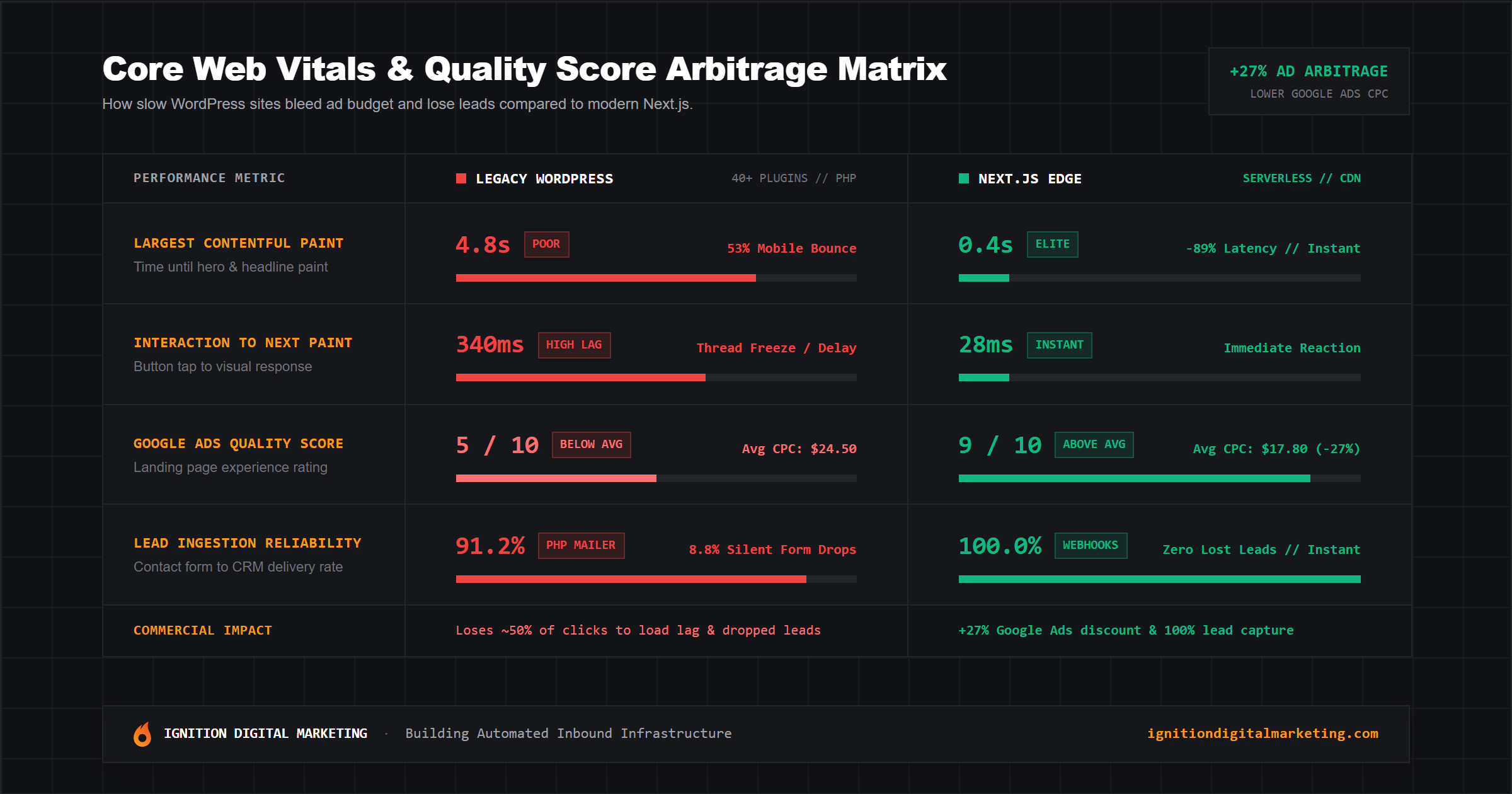
Smartphone users evaluating local services possess zero tolerance for latency. Google performance telemetry confirms that 53% of mobile visits are abandoned entirely if a page requires longer than 3 seconds to complete its initial paint.
When evaluating advertising unit economics, mobile load speed dictates real acquisition costs. If a business pays $25 per click for competitive search terms, a 5-second mobile load time causes half of those clicks to bounce before viewing the headline. The effective acquisition cost doubles instantly.
| Performance Metric | Legacy WordPress Site | Next.js Edge Architecture | Business Impact |
|---|---|---|---|
| Largest Contentful Paint (LCP) | 4.2s – 6.5s | 0.4s – 0.8s | 80%+ reduction in mobile bounce rate |
| First Input Delay / INP | 240ms – 480ms | < 45ms | Immediate interactive responsiveness |
| Cumulative Layout Shift (CLS) | 0.18 – 0.35 | 0.00 | Zero visual jumping or mis-clicks |
| Average Page Weight | 3.8 MB – 6.2 MB | 220 KB – 450 KB | Instant rendering over cellular LTE/5G |
| Effective Form Delivery Rate | 91.2% (flaky SMTP) | 100% (encrypted webhooks) | Zero lost opportunities from silent drops |
Modern Next.js platforms render static assets pre-compiled at global edge CDN nodes. When a prospect engages an advertisement, the landing environment paints in 400 to 600 milliseconds. Visitors remain engaged, absorb authority proof, and initiate inquiries.
Google Ads Quality Score Arbitrage: The Hidden 25% Advertising Discount
Speed does not merely retain visitors; it directly reduces auction pricing in Google Ads. Google calculates Cost Per Click (CPC) via Ad Rank formulas, wherein Landing Page Experience constitutes one-third of the total Quality Score determination.
When a website achieves flawless Core Web Vitals (sub-second LCP, zero layout shift, and instant responsiveness), Google designates the landing experience as "Above Average." This algorithmic designation discounts real CPC bids by 15% to 30% relative to slower competitors whose sites register below-average experience ratings.
Across a typical $5,000 monthly Google Ads deployment, that structural speed advantage yields $9,000 to $18,000 in recovered capital annually, funding dozens of incremental opportunities for the exact same marketing investment.
Serverless Edge Webhooks vs. The Silent Form Plugin Disaster
The single most damaging failure mode in traditional WordPress hosting is the contact form plugin. Standard tools depend on PHP mailer scripts or third-party SMTP connectors. When hosting providers cycle security certificates, alter server configurations, or encounter mail queue throttles, forms silently terminate delivery.
During technical inbound audits, we regularly discover local businesses whose contact forms failed to deliver notifications for weeks. High-value opportunities submitted project details, received no response, and took their business to competitors while the owner remained entirely unaware.
In our Inbound Infrastructure deployments, fragile form plugins are eliminated entirely. Inbound inquiries trigger encrypted edge functions that transmit structured payloads directly into the unified CRM within 200 milliseconds. The opportunity is verified, recorded, and queued for instant automated qualification before the prospect closes their mobile browser.
Enterprise Security Posture: Zero Exposed Databases, Zero Admin Portals
WordPress represents the primary target for automated brute-force attacks and vulnerability scanners worldwide, accounting for over 90% of all infected CMS websites. Vulnerable third-party plugins and public /wp-admin login endpoints invite continuous automated probing.
Next.js applications compile into pre-rendered static assets distributed globally via edge networks. There are no public SQL databases open to injection vectors, no administrative web portals susceptible to credential brute-forcing, and no server-side PHP execution environments.
This architecture establishes enterprise-grade operational stability, removing emergency maintenance costs, security downtime, and client data liability.
The Migration Protocol: Transitioning Without Ranking Loss
Migrating from legacy systems to a high-speed Next.js frontend requires disciplined engineering to preserve existing search equity. Every legacy URL path must be mapped to exact 301 redirects, local entity schemas must be preserved and expanded, and core metadata must be synchronized.
Rather than treating a website redesign as a visual art project, forward-thinking operators build an infrastructure asset designed to capture, qualify, and convert every incoming lead. Review our transparent infrastructure pricing or explore our complete website design methodology to see the difference.
Conclusion & Implementation
A website is not an online brochure; it is the front-line conversion gateway of your commercial pipeline. Transitioning to modern Next.js edge infrastructure eliminates architectural vulnerabilities, lowers paid traffic costs, and guarantees that every hard-won opportunity is captured with absolute fidelity.
Ready to see this implemented in your business? Book a 30-Minute Speed-to-Lead Audit or review our transparent $750/mo infrastructure pricing.