When local business leaders evaluate customer acquisition channels on Google, they frequently frame the decision as an either/or dilemma: Should we allocate budget toward Google Local Services Ads (Google Screened / Guaranteed) or invest in organic Local SEO to dominate the Google Maps 3-Pack? Understanding the economic reality of modern Google Search requires analyzing how both channels interact to capture high-intent commercial demand.
The Anatomy of Modern Local SERPs: How Google Segments Intent
The visual structure of Google Search engine results pages (SERPs) has evolved significantly. On mobile devices, the top 100% of the screen viewport for commercial local queries ("roofing contractor near me", "emergency plumber", "commercial litigation attorney") is dedicated to paid real estate.
At the absolute pinnacle sit Google Local Services Ads, featuring the company name, star rating, verified review count, and the prominent green Google Screened or Google Guaranteed badge. Directly beneath LSAs appear standard Google PPC search ads. Only below the paid tiers does the Google Maps 3-Pack appear, followed by traditional organic web listings.
Understanding this layout is crucial: searchers seeking immediate assistance gravitate toward the verified badges at the top, while research-driven decision-makers scroll down to evaluate the organic Map Pack.
Google Local Services Ads (LSAs): Unit Economics and Pay-Per-Lead Dynamics
Unlike traditional Google Ads where you pay for every website click regardless of outcome, LSAs operate on a direct pay-per-lead model. You are billed exclusively when a qualified prospect calls your business or submits a direct message through the Google interface.
For local service businesses requiring immediate customer volume, LSAs deliver substantial advantages: rapid verification, prominent trust badges, and the ability to dispute invalid leads (wrong numbers, out-of-service areas). However, lead costs can fluctuate dramatically during peak seasons, and acquisition ceases the moment budget is paused.
Furthermore, ranking within the LSA top 3 slots is determined by Google's internal auction formula: proximity to searcher, responsiveness to incoming leads, and crucially, recent review velocity and average star rating.
The Organic Google Maps 3-Pack: Building an Appreciating Digital Asset
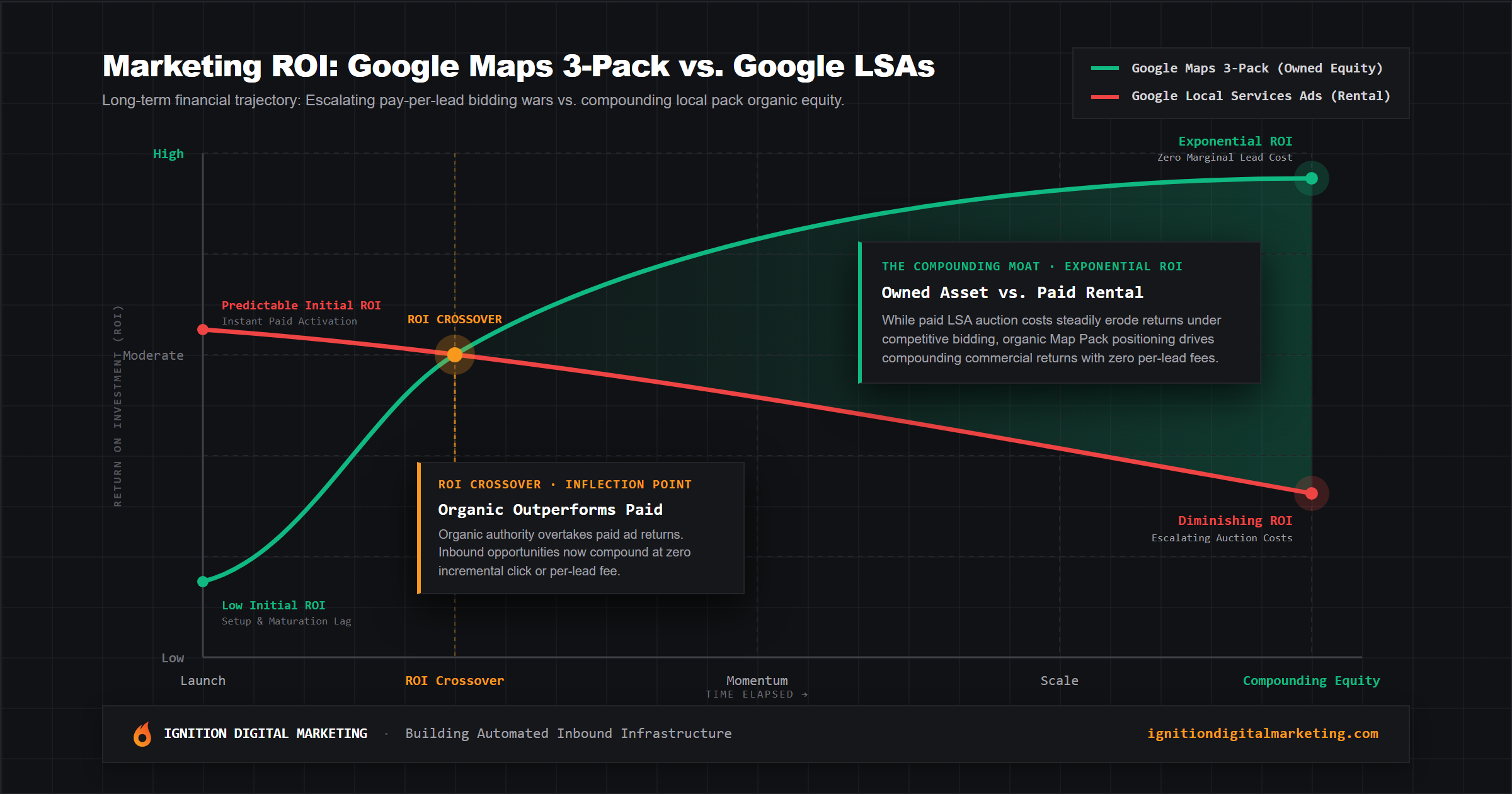
While LSAs function like rented marketing fuel, organic Google Maps 3-Pack positioning represents an appreciating digital real estate asset. Businesses that establish consistent rankings in the top 3 map positions across their primary service radius capture high volumes of trusted inquiries without paying toll fees on each click.
Winning and maintaining Map Pack dominance requires three synchronized pillars: meticulous local entity schema markup, localized service page architecture, and consistent geo-tagged Google review velocity.
Once established, Map Pack authority delivers compounding returns over time, driving down your business's blended Customer Acquisition Cost (CAC) and insulating your pipeline against paid advertising auction spikes.
Channel Comparison Matrix: Pricing, Intent, and Longevity Dynamics
| Acquisition Channel | Billing Mechanism | Setup Velocity | Commercial Intent | Longevity & Equity | Cost Scalability |
|---|---|---|---|---|---|
| Google LSAs (Screened) | Pay-Per-Lead ($25–$120/lead) | 3–7 Days (Post-verification) | Highest (Emergency & Immediate Need) | Temporary (Stops when ad budget pauses) | Linear (Spend scales directly with lead volume) |
| Google Maps 3-Pack | $0 Per Click / Lead (Organic) | 60–120 Days (Compounding) | High (Research & Reputation Driven) | Compounding (Long-term competitive moat) | Fixed investment (Yields declining CAC over time) |
| Standard Google PPC | Pay-Per-Click ($8–$50/click) | 24–48 Hours | High (Keyword specific) | Temporary (Stops when ad spend pauses) | Linear (Auction costs inflate over time) |
Evaluating this matrix demonstrates why neither channel should exist in isolation. Relying exclusively on LSAs leaves a business vulnerable to competitor bidding wars, while relying solely on organic SEO leaves immediate revenue on the table during the ranking maturation window.
The Review Velocity Flywheel: The Unified Ranking Core
The critical operational link connecting LSAs and the Map Pack is review velocity—the rate and consistency at which your business collects authentic 5-star Google customer reviews. Google utilizes review volume, recency, and customer sentiment as primary ranking signals across both platforms.
A business deploying an automated review generation infrastructure that captures 25+ new reviews monthly achieves dual-channel superiority: their LSA placement captures top auction positioning at lower bid costs, while their organic Google Business Profile ascends the Map Pack rankings across target zip codes.
One single backend operational system powers the growth of both acquisition channels simultaneously.
The Market Monopolization Blueprint: The Dual-Engine Strategy
The most profitable local enterprises execute a unified strategy: they deploy Google LSAs and targeted Search ads to capture immediate high-intent leads today, while simultaneously building dominant Google Maps SEO to secure organic dominance tomorrow.
Crucially, this front-end traffic must be backed by a sealed conversion backend. Pouring paid ad traffic or organic leads into a leaky intake pipeline wastes marketing capital. Explore our complete High-Intent Lead Generation services or learn how The Inbound Infrastructure maximizes the potential of every opportunity.
Conclusion & Implementation
Don't view paid ads and organic local SEO as opposing strategies. Deploy paid acquisition for immediate inbound volume while compounding organic Map Pack authority to build an unshakeable market moat that drives down acquisition costs over time.
Ready to see this implemented in your business? Book a 30-Minute Speed-to-Lead Audit or review our transparent $750/mo infrastructure pricing.