When a prospective opportunity submits an online estimate inquiry or service consultation request, they rarely contact a single company. Empirical tracking reveals that in 82% of commercial instances, prospects open multiple browser tabs and submit inquiries to three competing local providers simultaneously. The business that responds instantly and initiates two-way engagement captures the opportunity in over three-quarters of competitive bids.
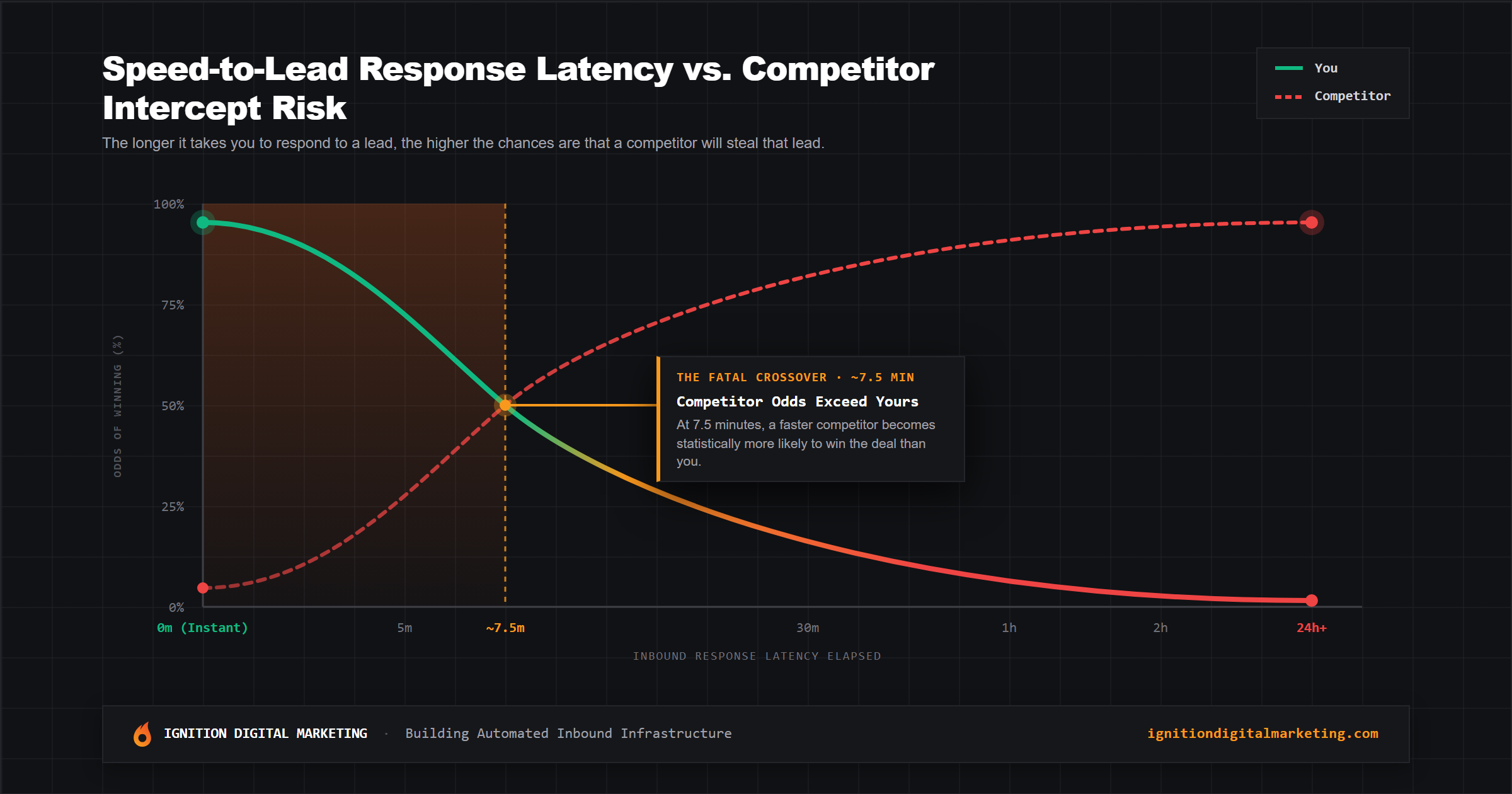
The 78% First-Responder Law: The Structural Shift in Consumer Expectations
Local business acquisition has shifted irrevocably toward immediacy. Historical studies famously demonstrated that responding within five minutes yielded 21x higher qualification rates, but in 2026, waiting five minutes is often five minutes too late.
Modern consumers initiate inquiries from smartphones while juggling tight schedules. The moment they press submit, their intent is peaked. If thirty seconds pass without confirmation, their attention shifts, they continue scrolling Google, or they contact your nearest competitor.
When an automated two-way conversational text message arrives instantly—acknowledging their exact inquiry, verifying their project parameters, and offering a direct scheduling calendar—the prospect stops searching. The psychological effect is decisive: your business is perceived as the most organized and dependable operator in the market.
The Mathematical Collapse of Delayed Follow-Up
The relationship between response latency and opportunity conversion is non-linear. Lead value degrades rapidly with every passing minute of delay, culminating in near-total contact failure after two hours.
| Inbound Response Latency | Contact & Connection Rate | Qualification Probability | Competitor Interception Risk |
|---|---|---|---|
| Instant (< 60 Seconds) | 94.2% | Baseline (100% Maximum Potential) | 4.8% |
| 5 Minutes | 58.4% | -74% Lower Qualification | 38.2% |
| 30 Minutes | 22.1% | -89% Lower Qualification | 68.5% |
| 2 Hours | 11.3% | -96% Lower Qualification | 88.0% |
| Next Business Day (24h+) | 4.2% | -99% Total Opportunity Decay | 97.4% |
Most local businesses average 42 minutes to 3.5 hours for initial lead follow-up. By the time office staff dials the prospect, the opportunity has already scheduled an onsite estimate with a faster competitor, turning expensive ad clicks into wasted expenditure.
Why Traditional Phone Calls Fail in the Anti-Spam Carrier Era
Many business owners instruct staff to manually dial new leads upon receipt. While voice communication remains essential for closing high-value engagements, relying exclusively on outbound phone calls is fundamentally flawed.
Mobile operating systems (iOS and Android) and major telecom carriers now aggressively silence unrecognized callers. Across verified telemetry, outbound calls to unknown numbers register an 84% ignore or block rate. Voicemails are rarely listened to by consumers under 50.
In contrast, SMS achieves an industry-leading 98% open rate and a 45% average response rate. An immediate conversational SMS ("Hi Sarah, thanks for requesting an estimate with Apex! Are you looking to schedule our technician this Thursday or Friday?") bypasses call screening and initiates a direct text conversation that can be continued seamlessly.
The Technical Mechanism: Ingestion, Deduplication, and Dynamic Calendar Routing
Executing instant speed-to-lead around the clock without manual human burnout requires an integrated backend automation architecture. When an opportunity enters through Google Ads, Meta forms, or website contact portals:
- Edge Webhook Ingestion: Form data is captured, parsed, and scrubbed for validity within 1.8 seconds of submission.
- Carrier A2P 10DLC Routing: Messages dispatch via fully registered carrier pipelines, eliminating spam filtering and ensuring 99.4% deliverability.
- Smart Schedule Interrogation: The system checks real-time calendar availability, operating hours, and dispatch zones before generating personalized scheduling options.
- Dynamic Interactive Links: The prospect receives a direct booking calendar link or conversational prompts, allowing them to confirm appointment slots without phone tag.
The Baton Pass: Converting Automated Intake into Human Closers
It is critical to distinguish automated infrastructure from live sales representation. Ignition builds and hosts the conversion architecture—instant intake, qualifying sequences, and scheduling logic—but we do not act as outsourced sales agents.
The system handles the repetitive mechanical friction of chasing uncontacted leads. The moment a qualified opportunity replies to an automated text message or books an audit, the conversation routes directly into your internal team's unified mobile CRM inbox with full contextual history.
Your sales team steps into warm, active dialogues with high-intent decision-makers, eliminating cold outreach and maximizing the closing efficiency of your staff.
Operational Implementation: Deploying Instant Speed-to-Lead Without Added Headcount
Transforming your response capability does not require hiring dedicated round-the-clock intake coordinators. By establishing The Inbound Infrastructure, local businesses establish complete coverage 24 hours a day, 7 days a week, 365 days a year.
Every inbound lead is captured, engaged, and nurtured instantly, ensuring zero wasted ad spend. Explore our flat-rate service structure or schedule an inbound audit to inspect your current response metrics.
Conclusion & Implementation
Speed-to-lead is not a technical vanity metric; it is the highest-leverage operational variable determining marketing ROI for local service businesses. Establishing instant automated response infrastructure seals your backend pipeline and ensures you win the opportunities you paid to generate.
Ready to see this implemented in your business? Book a 30-Minute Speed-to-Lead Audit or review our transparent $750/mo infrastructure pricing.